
Palworld's Elemental Chart Is Still Playing Catch-Up to Pokémon in 2026
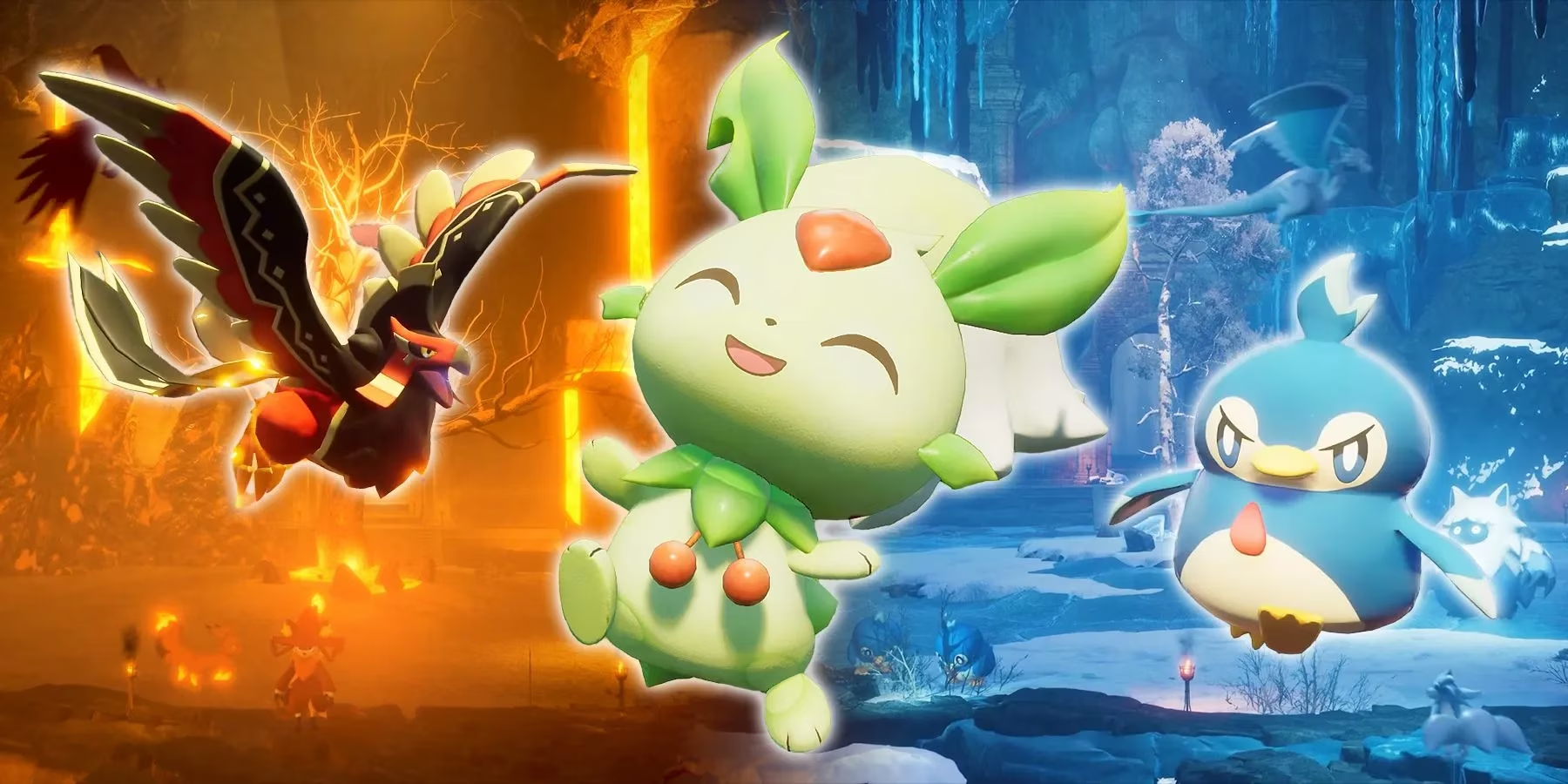
When Pocketpair unleashed Palworld upon an unsuspecting planet, it didn't just break sales records—it shattered every expectation a creature-collector RPG could have. Millions of players dove headfirst into a world where Pals could build factories, water crops, and occasionally unload an assault rifle into an unfortunate poacher. Yet, for all its chaotic charm, a nagging sense of incompleteness has hovered over one core feature: the elemental affinity system. By 2026, after numerous content drops and roster expansions, the Pal element chart still looks like a kindergarten sketch next to the sprawling masterpiece that Pokémon has polished for nearly three decades.
The numbers alone tell an awkward story. Pokémon struts around with eighteen fully realized types (nineteen if you count the cosmic oddball Stellar), each with a tangled web of strengths and vulnerabilities that could make a calculus professor weep. Meanwhile, Palworld settled for nine elements—Dark, Dragon, Electric, Fire, Grass, Ground, Ice, Neutral, and Water. Sure, eight of them share names with their Pokémon counterparts, and Neutral is basically Normal wearing a fake mustache, but the resemblance ends there. Quantity isn't everything, but when the entire strategic depth of a monster-taming title hinges on rock-paper-scissors dynamics, having only nine options feels like showing up to a chess match with just pawns.
| Palworld Element | Pokémon Equivalent | Notable Shortcomings |
|---|---|---|
| Fire | Fire | Only strong vs. Grass/Ice, weak to Water |
| Water | Water | Only strong vs. Fire, weak to Electric |
| Grass | Grass | Strong vs. Ground, weak to Fire |
| Electric | Electric | Strong vs. Water, weak to Ground |
| Ground | Ground | Strong vs. Electric, weak to Grass |
| Ice | Ice | Strong vs. Dragon, weak to Fire |
| Dragon | Dragon | Strong vs. Dark, weak to Ice |
| Dark | Dark | Strong vs. Neutral, weak to Dragon |
| Neutral | Normal | No strengths, weak to Dark (often resistless) |
The real pain point isn't just the paltry count—it's the one-note interactions. Almost every Pal element has exactly one strength and one weakness, as if the developers worried that complexity would scare the player base away. In contrast, a single Grass-type in Pokémon can ruin the day of Ground, Rock, and Water types while cowering in fear from Fire, Flying, Ice, Poison, and Bug. That asymmetric web forces trainers to build versatile teams, constantly juggling coverage moves and unexpected type matchups. In Palworld, you bring the fiery fox to torch the leafy deer, then you switch to the watery turtle to douse the fiery fox, and the tactical ceiling might as well be a low-hanging cloud. There's no spice, no "gotcha" moments—just a glorified element version of The Very Hungry Caterpillar.
Consider the Grass Pal conundrum. A fluffy leaf-bear is labeled "strong against Ground" and "weak to Fire." That's it. Meanwhile, its Pokémon cousin can sip the vitality out of Rock-types with a single Giga Drain while simultaneously blocking Electric attacks thanks to Lightning Rod. The difference isn't just mechanical—it's philosophical. Pokémon dares players to think in cascading chains of advantage, where a well-timed switch can flip a losing battle into a victory lap. Palworld, even in 2026, still struggles to offer anything beyond the most linear of tactical choices.
Optimists will point to Pocketpair's post-launch track record. The developer has added new Pals, new biomes, and even some wildly ambitious raid bosses. Yet the elemental system remains stubbornly shallow. Why not introduce a Metal element that resists Normal attacks but crumbles under Electric pressure? How about a Wind affinity that disrupts Dragon's reign? The tools for evolution are right there, gathering dust while players dream of a meta where they can field a diverse squad instead of cycling through the same predictable counters. Some datamined hints suggest Pocketpair is at least sketching ideas for additional elements, but as of mid-2026, the official chart still looks like a trimmed-down version of a game released in 1996.
Of course, it’s unfair to demand that an early-access indie title instantly replicate thirty years of Type Chart refinement. Pokémon’s own history is littered with balance patches, type introductions (Fairy, anyone?), and the gradual death of the Psychic-type tyranny. Palworld deserves time to iterate, and its runaway success grants it that luxury. But indie charm doesn’t excuse a design philosophy that treats elemental affinities as an afterthought. The game already flirts with brilliance through its fusion of survival mechanics and monster-collecting loop; enriching the combat backbone would turn it from a meme factory into a genuine genre heavyweight.
One can’t help but chuckle at the irony. Palworld arrived on the scene with a “we’re not afraid to be different” swagger, delighting in the absurdity of Pals wielding weaponry and toiling in sweatshops. Yet when it comes to the game’s most fundamental combat engine, it clings to a timid simplicity that even Pokémon Red and Blue outgrew after its first sequel. Perhaps Pocketpair is secretly saving a massive type overhaul for the 1.0 release, ready to shock players with a revamped strategic layer. Until then, min-maxers must content themselves with the nine-note symphony, hoping the next patch brings more than just another adorable fire cat.
In the grand monster-taming theater, the element of surprise matters. And right now, Palworld’s elemental chart provides very little of it.
Leave a Comment
0 Comments